
Why Retirees Quietly Outperform 20-Somethings in Prop Firm Trading
The trading industry markets to twenty-somethings chasing Lamborghinis. But the behavioral neuroscience and payout statistics tell a very different story.
If you scroll through YouTube, TikTok, or Instagram, prop firm trading looks like a high-speed video game designed exclusively for twenty-somethings. You see six monitors glowing in a dark bedroom, frantic mouse clicking, and influencers boasting about passing a $150,000 evaluation in 45 minutes on zero-day options or maximum-contract Nasdaq futures.
It is loud, dramatic, and captivating. It is also the exact reason over 90% of those accounts blow up within their first three weeks.
Meanwhile, a quiet revolution is happening across futures trading communities. Men and women in their 50s, 60s, and 70s—trading on a single laptop from a kitchen counter or home office—are passing evaluations, maintaining funded accounts for months, and taking home consistent four-figure monthly payouts.
Why? Because when you strip away the hype, prop firms are not designed to test your twitch reflexes. They are mathematical traps designed to punish impulsivity and reward emotional regulation, process adherence, and patience.
Here is the cognitive neuroscience, life psychology, and financial reality behind why older traders hold a decisive edge over twenty-somethings in the prop firm arena.
The Fundamental Contrast
A 22-year-old trades to get rich tomorrow. A 64-year-old trades to protect their capital today and add dependable supplemental cash flow to their retirement. In trading, the person desperate for money almost always transfers their account balance to the person who can afford to wait.
1. The Neuroscience of Patience: Emotional Regulation Improves With Age
Popular culture tells us that the human brain peaks at age 25 and declines thereafter. While it’s true that raw processing speed and reaction time (the skills needed for first-person shooter games) peak in young adulthood, cognitive neuroscience paints a very different picture for decision-making under stress.
Research from the Stanford Center on Longevity and Harvard Medical School consistently confirms that emotional regulation and distress tolerance actually peak in our 50s and 60s:
- Lower Dopamine Volatility: Younger brains experience sharper dopamine spikes when anticipating rewards, creating an irresistible urge to gamble, take excessive risks, and overtrade. Older adults produce more stable neurochemical responses, blunting the addictive pull of the flashing green P&L.
- Prefrontal Cortex Dominance: Decades of lived experience strengthen the neural pathways between the amygdala (fear and aggression) and the prefrontal cortex (rational restraint). When a trade goes against a retiree, they are statistically far less likely to "revenge trade" than someone in their early twenties.
- The Ability to Sit on Your Hands: The hardest skill in trading is sitting in front of a chart for two hours and doing absolutely nothing because your setup didn't appear. Young traders perceive inactivity as wasted time; retirees understand that capital preservation is an active, productive decision.
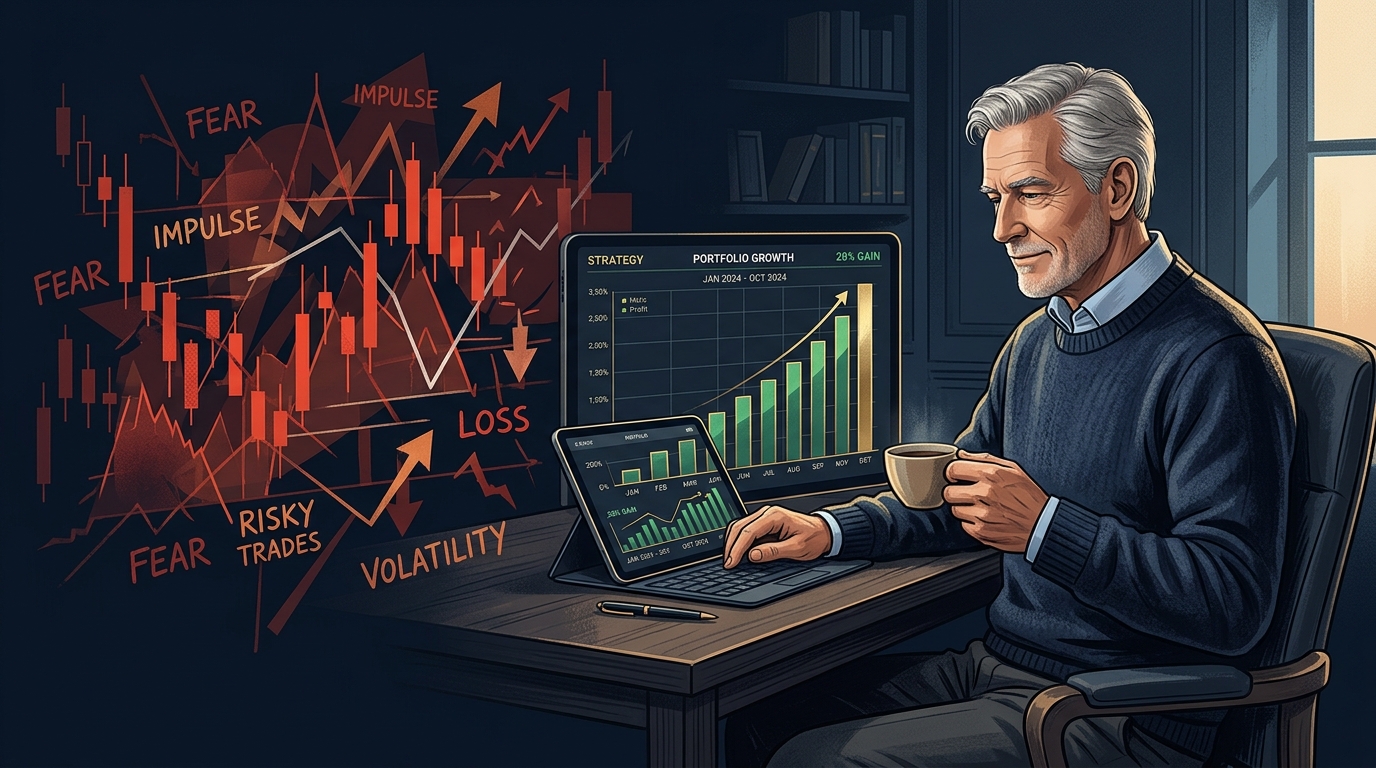
2. Career Muscle Memory: 30+ Years of Following Checklists
Consider the typical career of someone entering retirement. Whether you were an engineer, a nurse, an accountant, a military officer, a small business owner, or a corporate manager, your entire professional life was defined by:
- Standard Operating Procedures (SOPs)
- Risk assessment and contingency planning
- Accountability to budgets and strict rules
- Managing through setbacks without panicking
What is a prop firm rule set if not a corporate SOP?
When a firm like Topstep, Tradeify, or Alpha Futures says: "Do not lose more than $1,000 in a day, do not exceed your drawdown limit, and keep your best day under 40% of total profits," a twenty-something sees an annoying obstacle to be skirted. A retiree sees a simple compliance document.
Older traders don’t take rule breaches personally. They understand that if you violate the safety policy on an industrial site or misfile a tax return, you get penalized. Treating trading as a checklist-driven business instead of an adrenaline rush is a superpower.
3. The Absence of Desperation (Trading With Nothing to Prove)
Nothing destroys trading performance faster than "scared money."
When a 23-year-old buys a $150 prop firm evaluation, that evaluation often represents a substantial slice of their disposable income. They might have college loans, rising rent, or car payments looming. They need the payout to validate their life choices or escape a job they hate.
That desperation turns every open 2-point pullback on the E-mini S&P into an existential crisis. They cut winners too early out of terror, and they let losers run because they cannot stomach admitting defeat.
The Retiree's Psychological Cushion
A retiree trading futures usually has their baseline living expenses covered by Social Security, a pension, or a long-term IRA/401(k) portfolio. A $500 payout from Tradeify or MFFU is fantastic—it pays for flights to see the grandkids, a nice dinner, or golf dues. But if an evaluation account fails, nobody is getting evicted. That emotional detachment is the exact state of mind required to execute flawless risk management.
4. Realistic Financial Goals: Compounding vs. Moonshots
Ask a young day trader what their goal is, and they will tell you: "I want to make $10,000 this month, scale to 20 accounts, quit my job, and buy an exotic car."
Ask a retired trader what their goal is, and they will tell you: "If I can consistently make $200 a morning trading two micro contracts and withdraw $1,200 to $2,000 a month to supplement my income, I am thrilled."
That difference in expectation changes everything about how you trade:
| Behavior | The 20-Something Trap | The Retiree Strategy |
|---|---|---|
| Position Sizing | 3–5 Minis (ES/NQ) — $600/move | 2–4 Micros (MES/MNQ) — $10–$20/point |
| Session Duration | Stares at screens 6–8 hours a day | Done in 60–90 minutes (NY Open) |
| Reaction to a Red Day | Revenge trades to get back to even | Shuts the laptop and plays pickleball |
| Consistency Compliance | Frequently violates 30% single-day profit cap | Natural balance across every session |
5. The Humility to Accept Being Wrong
Youth is famous for stubborn certainty. When you are in your early twenties, your ego is intensely wrapped up in proving how smart you are. Admitting that a market thesis was completely wrong feels like a personal humiliation.
By the time you reach retirement, life has humbled you multiple times:
- You lived through the dot-com crash of 2000.
- You navigated the Global Financial Crisis of 2008.
- You raised children, managed career crises, and survived unpredictable curveballs.
You know beyond a shadow of a doubt that the market does not care about your opinions, your political views, or where you bought your contract.
When a retiree's stop-loss gets hit, they don't scream at their monitor or double their position size in defiance. They take the small $75 loss, recognize the setup invalidated, and move on with their day. In futures prop trading, taking small losses gracefully is the single trait that separates funded traders from perpetual evaluation buyers.
How Retirees Can Maximize Their Edge in 2026
If you are an older trader or approaching retirement and considering futures prop firms, lean into your natural strengths:
Pick End-of-Day (EOD) or Static Drawdown Firms
Avoid intraday trailing watermarks that trail open floating profits in real time. Choose firms like Alpha Futures (EOD trail), Tradeify (Growth plan), or Elite Trader Funding (Static plans) that give your trades room to breathe without heart palpitations.
Stick Exclusively to Micro Contracts
Trade 2 to 4 Micro E-minis (MES or MNQ). A bad morning will only cost you $60 to $120—well within your daily drawdown limits—letting you sleep peacefully every night.
Embrace the "One Hour a Day" Routine
Wait out the chaotic 9:30 AM open. Trade the high-probability window between 9:45 AM and 10:45 AM ET. Catch one clean move, lock in $150–$300, close your laptop, and go enjoy your day.
The Final Word
Never let flashy social media videos convince you that you are "too old" or "too slow" for prop firm trading. Fast hands do not make money in financial markets; disciplined minds do.
You spent an entire lifetime acquiring the emotional control, work ethic, and perspective that young day traders spend hundreds of blown accounts trying to learn. In the quiet world of funded prop accounts, the turtle doesn't just finish the race—he takes home the payout.
Related Articles for Older Traders
The "One Hour a Day" Routine
How to build a low-stress morning trading habit that leaves the rest of your day completely free.
The Midday Boredom Trap
Why retirees often overtrade during slow lunch hours, and the exact rules to protect your gains.
Why Micros Are the Gold Standard
1/10th the risk, minimal tick value, and zero stress: the ideal contract size for retirement accounts.
Prop Firm Rankings for Retirees
See which prop firms score highest on rule simplicity, safety, and payout reliability.
Brendan Nolan
Retired Trader & Founder
After spending 25+ years as a Product Management executive designing platforms for the nation's top 401(k) and retirement providers, Brendan transitioned into active futures trading in his 60s. He built PropFirmRetiree to help late-career professionals apply disciplined, risk-first principles to prop firm trading.
Read Brendan's Story →