
The Reality of Prop Firm Trading: What the Statistics Tell Us
What does the data actually say about prop firm success rates? We break down evaluation pass rates, funded account lifespans, average payouts, and why most traders fail.
Every year, hundreds of thousands of traders purchase prop firm evaluations with the goal of trading six-figure funded accounts. While the opportunity is real, the statistics paint a clear picture: long-term success depends far more on risk management than on finding the “perfect” trading strategy.
Below, we examine the hard numbers behind the proprietary trading industry, outlining average pass rates, funded account lifespans, typical payouts, and the key behaviors that separate successful funded traders from the rest.
1. Evaluation Pass Rates
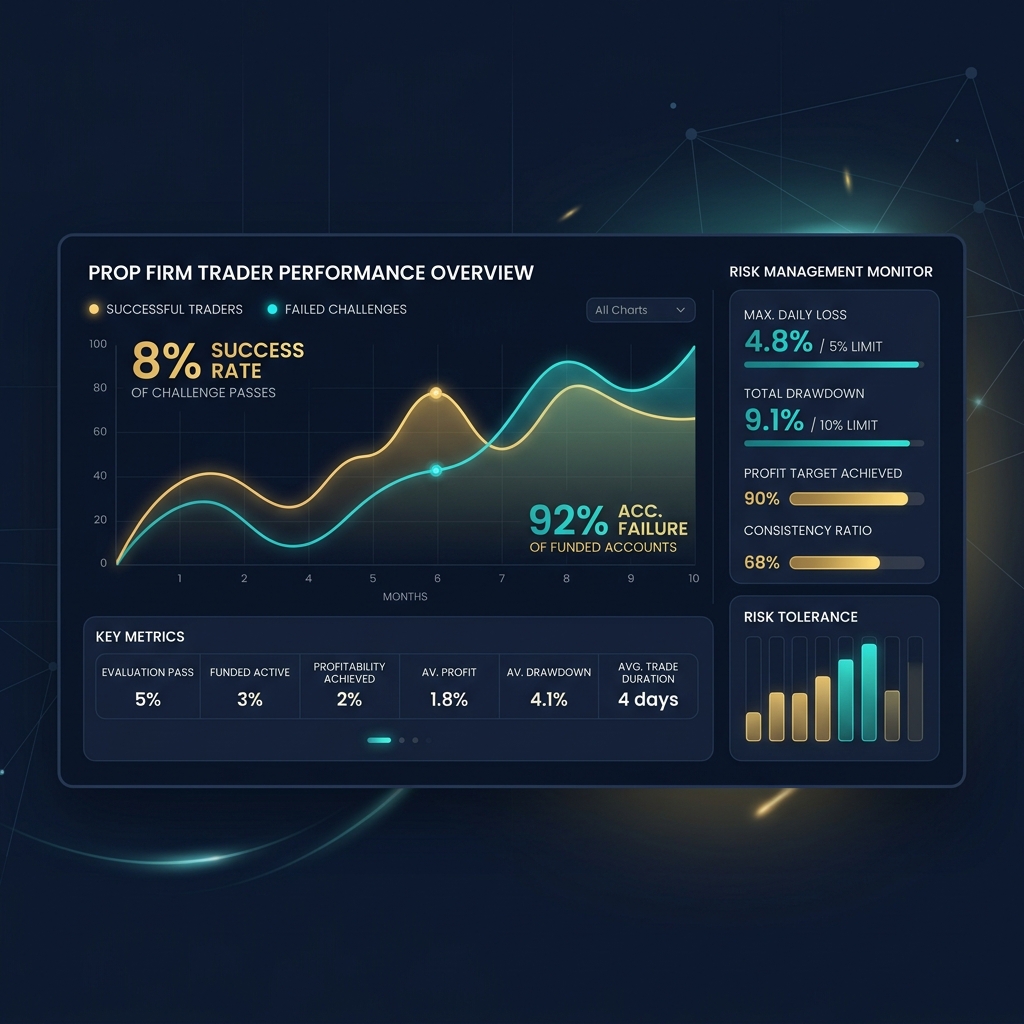
Industry estimates suggest that only 5–15% of traders pass an evaluation on their first attempt. Across multiple attempts, approximately 8–15% of traders eventually earn a funded account.
Interestingly, estimated pass rates vary significantly by account size:
- $25K Account: 12–15% pass rate
- $50K Account: 8–12% pass rate
- $100K Account: 5–10% pass rate
- $150K+ Account: 4–8% pass rate
Larger accounts tend to have lower pass rates because traders often increase their position size disproportionately, taking on far more risk relative to the drawdown buffer.
2. How Long Do Funded Accounts Last?
Receiving a funded account is only the beginning. Maintaining it is a completely different challenge. Most funded accounts fail relatively quickly due to the transition from the evaluation mindset to the pressures of real withdrawals.
Estimated funded account lifespan:
- Less than 30 days: 40–50% of accounts
- 1–3 months: 25–35% of accounts
- 3–6 months: 10–20% of accounts
- More than 6 months: 5–10% of accounts
Only a small percentage of traders manage to maintain a funded account for more than six months.
3. Average Lifetime Payouts Before Failure
Most funded traders receive at least one payout, but relatively few continue earning payouts over the long term. For the majority who do withdraw profits, the lifetime payouts remain within modest bounds before a rule breach occurs.
| Account Size | Average Total Lifetime Payout |
|---|---|
| $25K Account | $800 – $2,000 |
| $50K Account | $1,500 – $4,000 |
| $100K Account | $3,000 – $8,000 |
While exceptional traders may earn tens or even hundreds of thousands of dollars, they represent a very small minority of the total prop firm ecosystem.
4. Why Traders Lose Their Accounts
Most funded accounts are not lost because traders cannot find winning trades. Instead, they are lost because traders violate risk management rules, often due to emotional responses to normal market drawdowns.
Estimated causes of failure:
- Daily drawdown violations: 35–45%
- Trailing drawdown violations: 20–30%
- Overleveraging after losses (Revenge Trading): 15–25%
- Trading high-impact news: 10–15%
- Other rule violations: 5–10%
The biggest challenge is not predicting the market — it is managing risk consistently.
5. The Typical Trader Journey
A common progression for a prop firm trader looks like this:
- Purchase an evaluation.
- Fail the evaluation due to overleveraging or hitting drawdown.
- Purchase additional evaluations or resets.
- Eventually pass.
- Blow the funded account within one to three months.
- Repeat the cycle.
Many traders spend over $1,000 on evaluations and resets before developing the discipline to become consistently profitable.
6. Prop Firm Industry Snapshot
- Estimated global industry value: $12–20 billion
- Typical profit split: 80–100%
- Average trader age: Around 29 years
- Estimated funded rate: 8–15%
- Estimated traders receiving at least one payout: About 7% of all evaluation purchasers
7. What Successful Traders Do Differently
Traders who successfully maintain funded accounts and receive consistent payouts share a remarkably similar set of habits:
- Risk only 0.25–1% per trade: They keep position sizing small and allow trades room to breathe.
- Take 1–3 high-quality trades per day: They prioritize quality over quantity and avoid overtrading.
- Avoid revenge trading: They accept losses as part of the business and walk away.
- Avoid trading during major news events: Unless it is part of their explicit, tested strategy.
- Focus on consistency: They prioritize staying funded over trying to hit payout targets quickly.
- Protect capital above all else: They recognize that defending their drawdown buffer is their only real job.
📊 The Most Important Statistic
Most traders do not lose their funded accounts because they are bad traders — they lose them because they take too much risk.
A profitable strategy combined with poor risk management almost always leads to failure. Conversely, many traders with only modest win rates remain funded for years because they strictly control losses. The traders who survive are not usually the ones making the biggest winning trades; they are the ones who consistently avoid the catastrophic losing days.
Key Takeaway
Passing a prop firm evaluation is difficult, but maintaining a funded account is even harder. Industry data suggests that only about 1 in 10 traders earns a funded account, and only a fraction of those remain funded long enough to generate meaningful long-term income.
The lesson from the data is clear: discipline, consistency, and risk management — not aggressive trading — are the traits most closely associated with long-term prop firm success.
Brendan Nolan
Retired Trader & Founder
After spending 25+ years as a Product Management executive designing platforms for the nation's top 401(k) and retirement providers, Brendan transitioned into active futures trading in his 60s. He built PropFirmRetiree to help late-career professionals apply disciplined, risk-first principles to prop firm trading.
Read Brendan's Story →