
For retirees, requesting a prop firm payout is a major milestone. However, unlike traditional retail trading on your own capital, prop firm payouts are not treated as capital gains. Instead, they are classified as self-employment income, which introduces complex tax rules that can directly impact your retirement benefits.
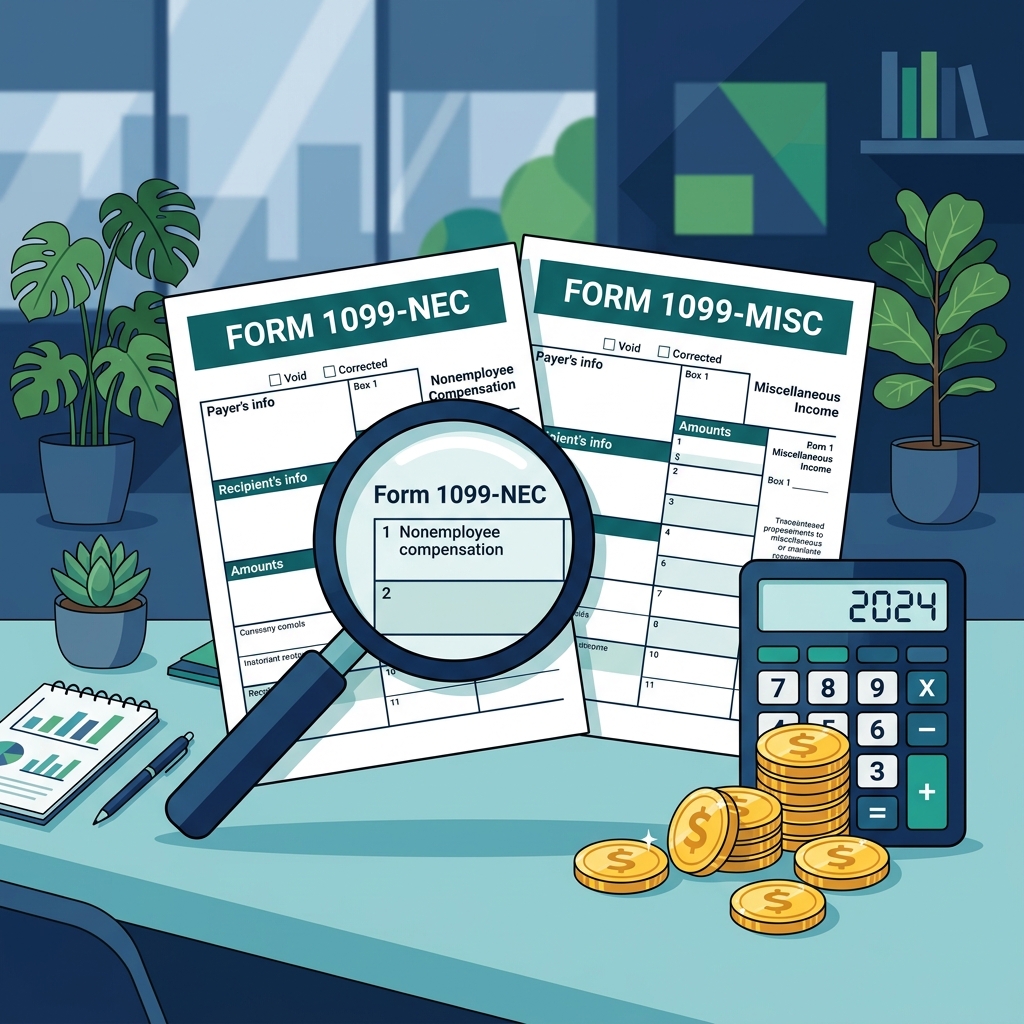
Understanding whether you receive a Form 1099-NEC or a Form 1099-MISC is the key to managing your tax burden. Many older day traders are surprised to learn that their payouts might trigger self-employment taxes, affect their Social Security benefits, or even raise their Medicare premiums.
In this guide, we will break down the exact tax classifications of prop firm income, compare Form 1099-NEC vs 1099-MISC, and outline the critical rules retirees must follow to stay compliant and protect their fixed income.
The Core Distinction: Performance Service vs. Trading Capital
In a normal retail trading account at a broker like Fidelity or Interactive Brokers, your profits are subject to capital gains tax. Under IRS Section 1256, futures contracts even get a favorable 60/40 tax split (60% long-term, 40% short-term capital gains rates), regardless of how long you hold the trade.
Prop firm income is entirely different.
Because you are trading the firm’s capital (or simulated capital B-book models) and getting paid a portion of the rewards as a contractor, the IRS does not view this as capital gains. You do not own the underlying assets. Instead, you are providing a trading performance service. Consequently, your payouts are classified as **ordinary earned income** (nonemployee compensation).
Form 1099-NEC: The Industry Standard
If you are a U.S. trader and earn $600 or more in a calendar year from a prop firm, the firm is legally required to report these payouts to the IRS using Form 1099-NEC (Nonemployee Compensation).
Almost all major futures prop firms — including Topstep, Apex, and Tradeify — issue Form 1099-NEC. This form tells the IRS that you are an independent contractor (sole proprietor) and that the income should be reported on Schedule C (Profit or Loss From Business) of your Form 1040.
💡 Why Schedule C Matters for Write-offs
Because Form 1099-NEC income is reported on Schedule C, you are treated as a business owner. This allows you to deduct ordinary and necessary business expenses to reduce your net taxable income. You can write off your evaluation fees, platform data subscriptions, trading software, internet bills, and home office expenses.
Form 1099-MISC Box 3: The "Other Income" Debate
Some traders and tax preparers argue that since you are trading in a simulated demo environment and not executing live orders on an exchange, you are not actually performing a "service" for the prop firm. Instead, you are receiving a prize or miscellaneous reward.
Under this view, payouts should be reported on Form 1099-MISC Box 3 (Other Income).
The difference is massive:
- 1099-NEC: Subject to ordinary income tax PLUS a 15.3% self-employment tax (Schedule SE).
- 1099-MISC Box 3: Subject only to ordinary income tax. It bypasses the 15.3% self-employment tax entirely.
While avoiding 15.3% tax sounds tempting, **reporting prop firm payouts as Form 1099-MISC Box 3 is a significant audit risk**. If a prop firm files a 1099-NEC with the IRS, the IRS matching system expects to see that exact amount reported on Schedule C. If you report it elsewhere, the system will flag the mismatch and automatically issue a tax adjustment notice.
3 Critical Tax Impact Areas for Retirees
1. Self-Employment Tax (Schedule SE)
Net earnings from self-employment of $400 or more trigger a **15.3% tax** composed of 12.4% for Social Security and 2.9% for Medicare. For retirees who are already receiving Social Security benefits or are on Medicare, this is a direct, additional out-of-pocket cost.
2. Social Security Earnings Test (Under FRA Only)
If you have reached your **Full Retirement Age (FRA)** (typically between 66 and 67 depending on birth year), you can earn unlimited income without affecting your monthly Social Security check.
However, if you take early retirement and are **under your FRA**, you are subject to the **Earnings Test**:
- If your earned income (including Schedule C prop firm payouts) exceeds the annual limit (around **$22,320 - $24,000**), the SSA will withhold **$1 in benefits for every $2** you earn over the limit.
- Only active earned income counts. Passive investment distributions do not count. Form 1099-NEC independent contractor income definitely counts.
3. Medicare Premium Surcharges (IRMAA)
Your Medicare Part B and Part D premiums are determined by your Modified Adjusted Gross Income (MAGI) from two years prior. This is known as **IRMAA (Income-Related Monthly Adjustment Amount)**.
Both 1099-NEC and 1099-MISC income increase your MAGI. If your total income crosses a threshold (such as $103,000 for single filers or $206,000 for married couples), your monthly Medicare premiums can spike by **40% to 200%**. Retirees must track their total income closely to avoid crossing these premium cliffs.
How to Mitigate the Tax Burden
Fortunately, retirees have several legal strategies to shield their prop firm payouts from heavy taxation:
1. Deduct Business Expenses (Schedule C)
Deduct every legitimate trading expense. Every failed evaluation, platform reset, data feed charge, and trading journal subscription decreases your net Schedule C income, which directly lowers both self-employment and ordinary income taxes.
2. Single-Member LLC & Solo 401(k)
Establishing a single-member LLC allows you to set up a **Solo 401(k)**. As an independent contractor, you can make employer contributions from your prop firm payouts directly into a tax-deferred Solo 401(k), reducing your taxable income by up to 25% of net business profits.
3. Track Your Medicare Thresholds
Keep a spreadsheet of your yearly income. If you are close to an IRMAA bracket threshold, consider pausing your prop payouts at the end of the year or deferring withdrawals to the next tax year to prevent a permanent premium increase.
The Bottom Line
Prop firm trading is a fantastic way for retirees to grow their capital safely, but the IRS treats this as earned contractor compensation (Form 1099-NEC) rather than capital gains.
Expect to pay self-employment tax, plan around the Social Security earnings limit if you are under your Full Retirement Age, and track your total MAGI to avoid IRMAA Medicare surcharges. By treating your trading as a business and leveraging tax write-offs or Solo 401(k) contributions, you can keep your taxes low and protect your hard-earned payouts.
⚠️ Disclaimer
Tax laws are highly complex and vary significantly based on your total income, age, and location. This article is for educational purposes only. Always consult a certified public accountant (CPA) or a qualified tax advisor who specializes in trader taxation before filing your taxes.