
How Prop Firm Payouts Are Taxed for US Retirees in 2026
Demystifying the 1099-NEC. What happens when you request a payout, and how does it impact your Social Security and Medicare premiums?
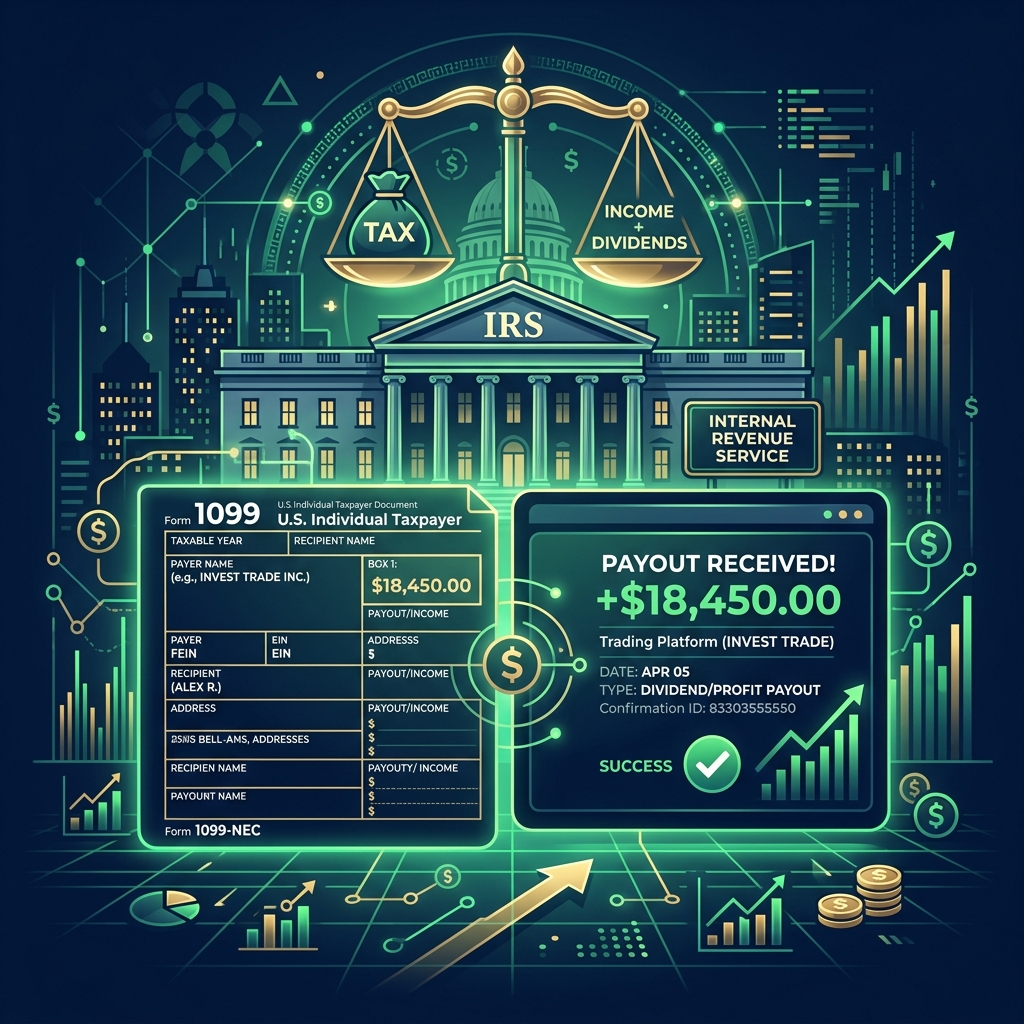
When you finally hit your profit target and request your first payout from a prop firm like Topstep or Tradeify, the celebration is usually followed immediately by a wave of anxiety: "How do I report this to the IRS? And how is this going to affect my retirement benefits?"
For a retail day trader risking their own money, profits are generally taxed as Capital Gains (often utilizing the favorable 60/40 rule under Section 1256 for futures). However, prop firms operate under an entirely different legal structure. You are not trading your own money. Therefore, the IRS views your relationship with the firm completely differently.
The Golden Rule: You Are an Independent Contractor
When you sign a funded account agreement with a US-based prop firm, you are signing an independent contractor agreement. You are effectively providing a "service" (generating trading profits) to the firm. In return, they pay you a "performance fee" (your 80-90% split).
What this means for your taxes:
- Your payouts are NOT capital gains.
- Your payouts ARE classified as ordinary income / self-employment income.
- If you earn more than $600 in a calendar year, the firm will issue you a 1099-NEC (Nonemployee Compensation) form at tax time.
- You are subject to both federal/state income tax AND Self-Employment Tax (Medicare + Social Security contributions, approx. 15.3%).
How This Impacts Your Retirement
Because this income is classified as earned income (self-employment) rather than passive investment income, it can have cascading effects on your retirement ecosystem.
🏛️ Social Security Earnings Limits
If you claim Social Security before your Full Retirement Age (FRA) and continue to "work" (which includes earning 1099-NEC income from prop firms), you are subject to the earnings test. In 2026, if you earn over the annual threshold (roughly $23,000+, verify exact current numbers with the SSA), your benefits will be temporarily reduced by $1 for every $2 you earn above the limit. If you are past your Full Retirement Age, this limit disappears, and you can earn unlimited prop firm payouts without it reducing your monthly SS check.
🏥 Medicare IRMAA Surcharges
Medicare Part B and Part D premiums are tied to your Modified Adjusted Gross Income (MAGI). If you have a massive year trading and pull $100,000 in payouts, that 1099-NEC income spikes your MAGI. This can trigger the Income-Related Monthly Adjustment Amount (IRMAA), causing your Medicare premiums to increase significantly two years later (as IRMAA looks at a 2-year lookback period).
The Silver Lining: Business Deductions
The fact that the IRS views you as an independent contractor business (a Sole Proprietorship, by default) comes with a massive benefit: You can deduct business expenses against your prop firm income on Schedule C.
If you were trading your own capital, deducting expenses is notoriously difficult unless you qualify for specialized "Trader Tax Status." But as a 1099 contractor for a prop firm, ordinary and necessary business expenses are generally deductible.
Common Potential Deductions to Discuss with your CPA:
- Evaluation Fees: The $50-$150 you pay for blown evaluations or resets.
- Platform & Data Fees: NinjaTrader licenses, Tradovate data feeds, TradingView subscriptions.
- Education: Trading courses, mentorships, and financial literature.
- Home Office: A percentage of internet and home costs if you have a dedicated trading room.
- Hardware: That new multi-monitor PC setup you bought specifically to run TopstepX.
Should You Open an LLC?
Many retired traders choose to set up a Single-Member LLC to receive their prop firm payouts. By default, an LLC is a "disregarded entity" for tax purposes, meaning it still flows to your personal tax return via Schedule C, but it provides a cleaner separation of your trading business from your personal finances.
Some advanced traders elect to have their LLC taxed as an S-Corporation. This allows them to pay themselves a "reasonable salary" and take the rest as distributions, potentially saving on the 15.3% Self-Employment tax. However, setting up and maintaining an S-Corp involves payroll and higher accounting fees. Your CPA will need to run the math to see if your payout volume justifies the setup cost.
Final Thoughts
Prop firm payouts are incredible tools for generating retirement income without risking your 401(k). Just remember to treat it like a business from day one. Save roughly 25-30% of every payout you receive in a high-yield savings account to prepare for your tax bill in April, track all of your evaluation fees meticulously in a spreadsheet, and hand it all over to a qualified CPA at the end of the year.
Brendan Nolan
Retired Trader & Founder
After spending 25+ years as a Product Management executive designing platforms for the nation's top 401(k) and retirement providers, Brendan transitioned into active futures trading in his 60s. He built PropFirmRetiree to help late-career professionals apply disciplined, risk-first principles to prop firm trading.
Read Brendan's Story →