
The Best Times to Trade Futures
Understanding global market sessions, volume overlaps, and the 'Golden Zone' for retirees.
One of the biggest advantages of trading futures is that the market is open nearly 24 hours a day, 5 days a week. However, just because the market is open doesn't mean you should be trading.
Success in day trading requires volume and volatility (price movement). Without volume, spreads widen, and markets chop sideways. To find the best trading opportunities, you need to understand how the three major global financial centers — Asia, Europe, and the US — drive trading activity throughout the day.
The 24-Hour Global Volume Cycle
Futures volume ebbs and flows in a predictable daily wave as different parts of the world wake up, go to their offices, and begin trading. The chart below illustrates this 24-hour cycle and highlights the critical overlap periods.
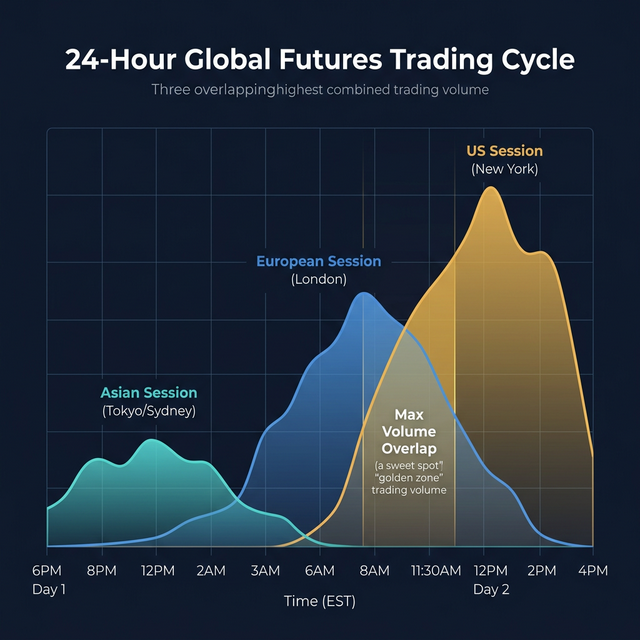
💡 Key Takeaway: The highest volume and cleanest price movements don't happen when a single region is trading alone. They happen during Session Overlaps — when two major global markets are open at the same time.
The Three Major Trading Sessions
The Asian Session (Tokyo / Sydney)
- Active Hours (EST): 6:00 PM – 3:00 AM
- Characteristics: Lowest volume, tightest ranges, slower price action.
The trading day officially starts here. While markets are open, US indices (like the S&P 500 or Nasdaq) move very slowly during the Asian session. Breakouts often fail, and the market tends to consolidate.For Retirees: Unless you are trading specific Asian instruments like the Nikkei or trading from a different time zone, it is usually best to avoid trading US indices during this session to avoid "choppy" price action.
The European Session (London / Frankfurt)
- Active Hours (EST): 3:00 AM – 11:30 AM
- Characteristics: Moderate to high volume, establishes early daily trends.
London is the financial hub of Europe. When London opens at 3:00 AM EST, volume picks up significantly. This session often sets the tone for the day, breaking the Asian session's consolidation.For Retirees: If you are an early riser on the US East Coast (e.g., 5:00 AM or 6:00 AM), this can be an excellent, less chaotic time to trade before the US market opens.
The US Session (New York)
- Active Hours (EST): 8:00 AM – 4:00 PM (Cash open at 9:30 AM)
- Characteristics: Highest volume, most aggressive volatility, largest price swings.
The US session completely dominates global volume, especially for index futures (ES, NQ) and commodities (Crude Oil, Gold). The real action begins when the US stock market officially opens at 9:30 AM EST. Volume spikes massively, creating the biggest opportunities (and risks) of the day.
The "Golden Zone": New York / London Overlap
This 3.5-hour window is the holy grail of trading volume. During this time, the massive institutional money from both London (Europe) and New York (US) are actively trading at the exact same time.
Why trade the overlap?
- Maximum Liquidity: With so many participants, orders are filled instantly with minimal slippage.
- Clean Trends: High volume fuels strong, sustained price trends rather than erratic, choppy sideways movement.
- News Catalysts: Almost all major US economic data (CPI, Non-Farm Payrolls) is released at 8:30 AM EST during this overlap.
The "A" Setup Window (9:30 AM - 11:00 AM)
For retirees, we recommend focusing entirely on the 90 minutes after the US stock market opens (9:30 AM EST). The initial morning volatility establishes the day's direction. You can catch one or two solid moves, hit your daily goal, and be done trading by 11:00 AM.
The "Lunchtime Chop" (12:00 PM - 1:30 PM)
By noon EST, Europe has gone home, and New York traders are at lunch. Volume drops dramatically. Price action becomes unpredictable, "choppy," and prone to false breakouts. Avoid trading during this time.
What if I miss the morning? (The PM Session)
If you prefer to sleep in, play golf in the morning, or just missed the AM action, the US afternoon session provides a secondary opportunity.
The "Power Hour" (2:00 PM – 4:00 PM EST)
As Wall Street returns from lunch and prepares for the 4:00 PM close, volume begins to swell again. Institutional funds balance their books, and day traders close out their positions.
- Action picks up after 2:00 PM EST.
- The trend often reverses or accelerates. The afternoon will generally either violently reverse the morning trend (a "V-bottom") or aggressively complete it.
- Caution: The final 15 minutes before 4:00 PM can be wildly erratic. Prop firms require you to close all positions by 4:59 PM EST anyway, but it is best to be flat by 3:45 PM.
Summary: The Retiree Trading Schedule
You retired to enjoy life, not to stare at charts for 12 hours a day. The beauty of the futures market's volume cycle is that you only need to be present during the most active windows.
| Time (EST) | Action | Why |
|---|---|---|
| 8:30 AM - 9:30 AM | Observe (Careful) | Pre-market. Major news drops at 8:30 AM causing violent spikes. |
| 9:30 AM - 11:30 AM | TRADE (Golden Zone) | US Cash Open + European Overlap. Maximum volume and cleanest trends. |
| 12:00 PM - 1:30 PM | DO NOT TRADE | Lunchtime chop. Low volume, false breakouts, high risk of getting stopped out. |
| 2:00 PM - 3:45 PM | Trade (Secondary) | PM Volume pushes into the close. Good secondary opportunity. |
Ready to Master the Morning Session?
Now that you know when to trade, the next step is finding a low-risk way to practice. Start with a firm that allows you to trade micro-contracts during the morning overlap.
Related Articles
Brendan Nolan
Retired Trader & Founder
After spending 25+ years as a Product Management executive designing platforms for the nation's top 401(k) and retirement providers, Brendan transitioned into active futures trading in his 60s. He built PropFirmRetiree to help late-career professionals apply disciplined, risk-first principles to prop firm trading.
Read Brendan's Story →